
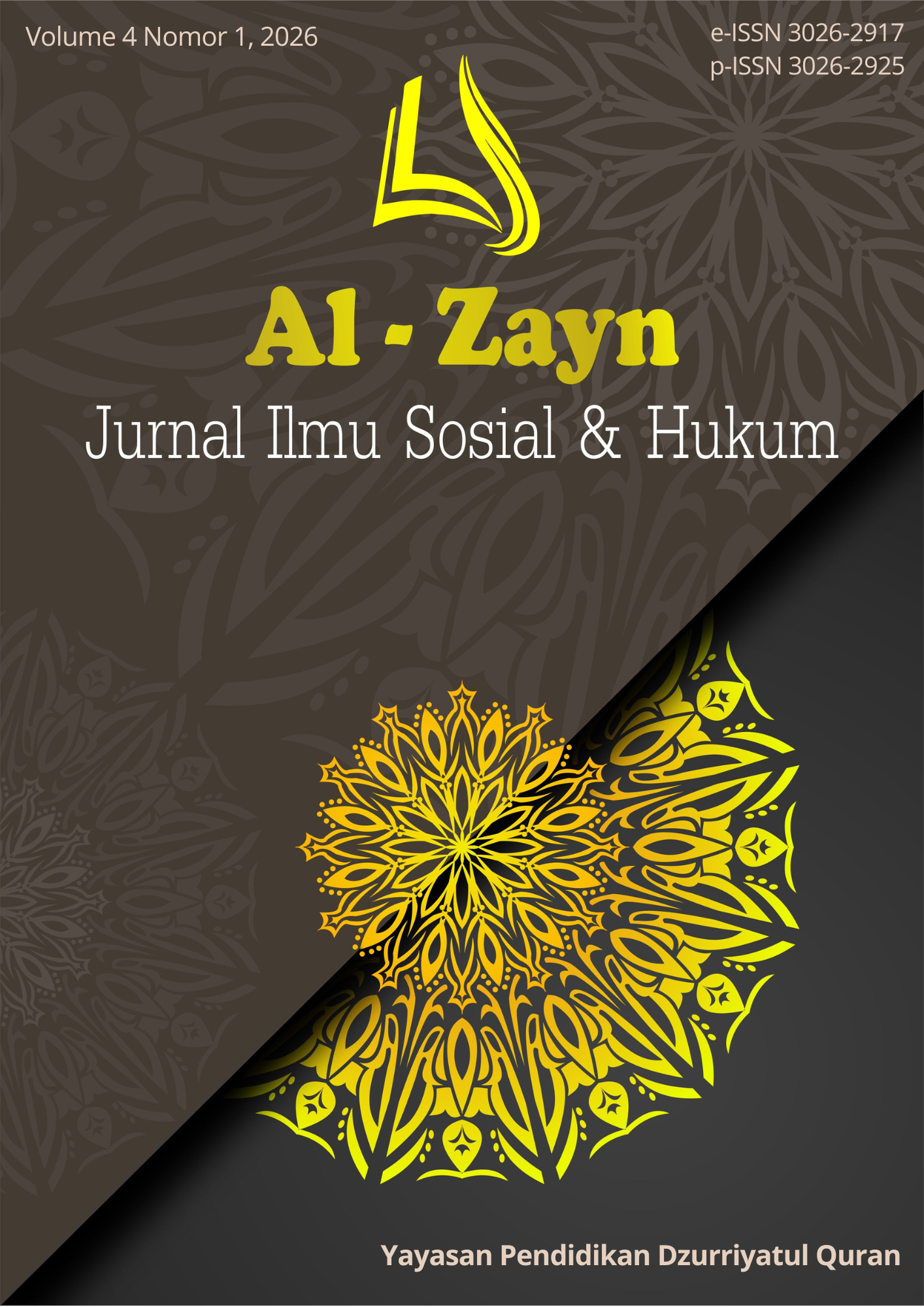
Ekojihad Melalui Inovasi Ekologi Perspektif Al-Qur`An
DOI:
https://doi.org/10.61104/alz.v4i1.3655Keywords:
ekojihad, inovasi ekologi, ekoteologi Islam, al-Qur’an, krisis lingkungan.Abstract
Penelitian ini bertujuan untuk merumuskan konsep ekojihad sebagai paradigma jihad kontemporer yang berlandaskan nilai-nilai al-Qur’an dalam merespons krisis ekologi global. Ekojihad dipahami tidak sekadar sebagai gerakan pelestarian lingkungan, tetapi sebagai ekspresi teologis dari tanggung jawab manusia sebagai khalîfah fî al-ardh yang berpijak pada prinsip hifzh al-bî’ah dan fiqh al-bî’ah. Penelitian ini menggunakan metode library research dengan pendekatan multidisipliner yang mencakup dimensi teologis, ekologis, dan filosofis dalam kerangka analisis eco-hermeneutik. Teknik analisis dilakukan melalui tafsir maudhû‘iy terhadap ayat-ayat al-Qur’an tentang amânah, mîzân, fasâd, dan ishlâh, yang dikombinasikan dengan analisis wacana kritis serta refleksi aksiologis. Hasil penelitian menunjukkan bahwa ekojihad memiliki relevansi praksis yang kuat melalui inovasi ekologi, yaitu integrasi nilai-nilai Qur’ani ke dalam bidang pendidikan, teknologi ramah lingkungan, ekonomi hijau, tata kelola lingkungan, dan gerakan sosial berbasis spiritualitas ekosentris. Pembahasan penelitian menegaskan bahwa ekojihad memiliki kesesuaian dengan berbagai teori ekologi kontemporer, seperti deep ecology, ekologi transpersonal, dan etika lingkungan global, namun tetap memiliki perbedaan mendasar karena ekojihad berpijak pada wahyu sebagai sumber normatif, bersifat tauhîdiy, dan menempatkan manusia sebagai subjek etis yang bertanggung jawab di hadapan Tuhan. Berbeda dengan pendekatan naturalistik dan humanistik, ekojihad menegaskan dimensi ‘ubûdiyyah dan spiritualitas teosentris dalam praksis ekologis. Penelitian ini menyimpulkan bahwa ekojihad melalui inovasi ekologi merupakan paradigma teologis-transformasional yang mengintegrasikan dimensi spiritual dan praksis ekologis secara normatif, aplikatif, dan berkelanjutan. Paradigma ini menawarkan kontribusi signifikan bagi pengembangan etika lingkungan Islam yang berakar pada al-Qur’an serta relevan dengan tantangan ekologis kontemporer.
References
Al-Maraghi, A. M. (1946). Tafsīr al-Marāghī (Vol. 1–30). Cairo: Muṣṭafā al-Bābī al-Ḥalabī.
Al-Mahalli, J., & al-Suyuthi, J. (2008). Tafsīr al-Jalālayn. Cairo: Dār al-Ḥadīth.
Al-Qaradhawi, Y. (1995). Fiqh al-awlawiyyāt: Dirāsah jadīdah fī ḍaw’ al-Qur’ān wa al-Sunnah. Cairo: Dār al-Shurūq.
Al-Qurthubi, M. b. A. (2006). Al-Jāmi‘ li-aḥkām al-Qur’ān (Vol. 1–24). Cairo: Mu’assasat al-Risālah.
Al-Razi, F. al-D. (1999). Mafātīḥ al-ghayb (Vol. 1–32). Beirut: Dār Iḥyā’ al-Turāth al-‘Arabī.
Al-Sa‘di, A. R. (2000). Taysīr al-karīm al-raḥmān fī tafsīr kalām al-mannān. Riyadh: Dār al-Salām.
Auda, J. (2006). Maqāṣid al-sharī‘ah as philosophy of Islamic law: A systems approach. London: International Institute of Islamic Thought.
Braungart, M., & McDonough, W. (2002). Cradle to cradle: Remaking the way we make things. New York, NY: North Point Press.
Dabashi, H. (2001). Authority in Islam: From the rise of Muhammad to the establishment of the Umayyads. New Brunswick, NJ: Transaction Publishers.
Daly, H. E. (1996). Beyond growth: The economics of sustainable development. Boston, MA: Beacon Press.
Dobson, A. (2007). Green political thought (4th ed.). London: Routledge.
Elkington, J. (1997). Cannibals with forks: The triple bottom line of 21st century business. Oxford: Capstone.
FAO. (2020). Global forest resources assessment 2020. Rome: Food and Agriculture Organization of the United Nations.
Fox, W. (1990). Toward a transpersonal ecology: Developing new foundations for environmentalism. Albany, NY: State University of New York Press.
Fox, W. (1995). Toward a transpersonal ecology (Revised ed.). Albany, NY: SUNY Press.
Glick, T. F. (1979). Islamic and Christian Spain in the early Middle Ages. Princeton, NJ: Princeton University Press.
Huber, J. (2008). New technologies and environmental innovation. Cheltenham: Edward Elgar Publishing.
Ibn Kathir, I. b. ‘U. (2017). Tafsīr al-Qur’ān al-‘Aẓīm (Vol. 1–8). Cairo: al-Maktabah al-Islāmiyyah.
IPBES. (2019). Global assessment report on biodiversity and ecosystem services. Bonn: IPBES Secretariat.
IPCC. (2021). Climate change 2021: The physical science basis. Cambridge: Cambridge University Press.
IPCC. (2023). Climate change 2023: Synthesis report. Geneva: Intergovernmental Panel on Climate Change.
Izzi Dien, M. (2000). The environmental dimensions of Islam. Cambridge: Lutterworth Press.
Jonker, J., & Scholtens, B. (2008). Sustainable development: The business of innovation. New Jersey, NJ: Wiley-Blackwell.
Kemp, R., & Pearson, P. (2007). Final report MEI project about measuring eco-innovation. Maastricht: MERIT.
Khalid, F. M. (2019). Signs on the earth: Islam, modernity and the climate crisis. London: Islamic Foundation.
Klein, N. (2014). This changes everything: Capitalism vs. the climate. New York, NY: Simon & Schuster.
Merchant, C. (1980). The death of nature: Women, ecology, and the scientific revolution. San Francisco, CA: Harper & Row.
Mulgan, G. (2012). The art of social innovation. London: Young Foundation.
Nasr, S. H. (1968). Man and nature: The spiritual crisis of modern man. London: George Allen & Unwin.
Nasr, S. H. (1996). Religion and the order of nature. New York, NY: Oxford University Press.
Naess, A. (1989). Ecology, community and lifestyle (D. Rothenberg, Trans.). Cambridge: Cambridge University Press.
Ozdemir, I. (2017). The ethical significance of environmental preservation in the Qur’an. Journal of Islamic Studies, 28(3), 345–361.
Pepper, D. (1996). Modern environmentalism: An introduction. London: Routledge.
Rockström, J., Steffen, W., Noone, K., et al. (2009). A safe operating space for humanity. Nature, 461, 472–475.
Sale, K. (1985). Dwellers in the land: The bioregional vision. San Francisco, CA: Sierra Club Books.
Sands, P., Peel, J., Fabra, A., & Mackenzie, R. (2021). Principles of international environmental law (4th ed.). Cambridge: Cambridge University Press.
Schimmel, A. (1994). Deciphering the signs of God: A phenomenological approach to Islam. Albany, NY: SUNY Press.
Shihab, M. Q. (2002). Tafsir al-Misbah: Pesan, kesan, dan keserasian al-Qur’an (Vol. 1–15). Jakarta: Lentera Hati.
Shiva, V. (1989). Staying alive: Women, ecology and development. London: Zed Books.
UNEP. (2019). Global environment outlook 6: Healthy planet, healthy people. Cambridge: Cambridge University Press.
WHO. (2020). Air pollution. Geneva: World Health Organization Press.
Wilson, E. O. (2016). Half-earth: Our planet’s fight for life. New York, NY: Liveright Publishing Corporation.
Downloads
Published
How to Cite
Issue
Section
License
Copyright (c) 2026 Nur Wakhid, Nur Arfiyah Febriani, Muhammad Hariyadi

This work is licensed under a Creative Commons Attribution-ShareAlike 4.0 International License.







 This work is licensed under a